
Numerosidad Number Atlas
The number 100,000, visualized
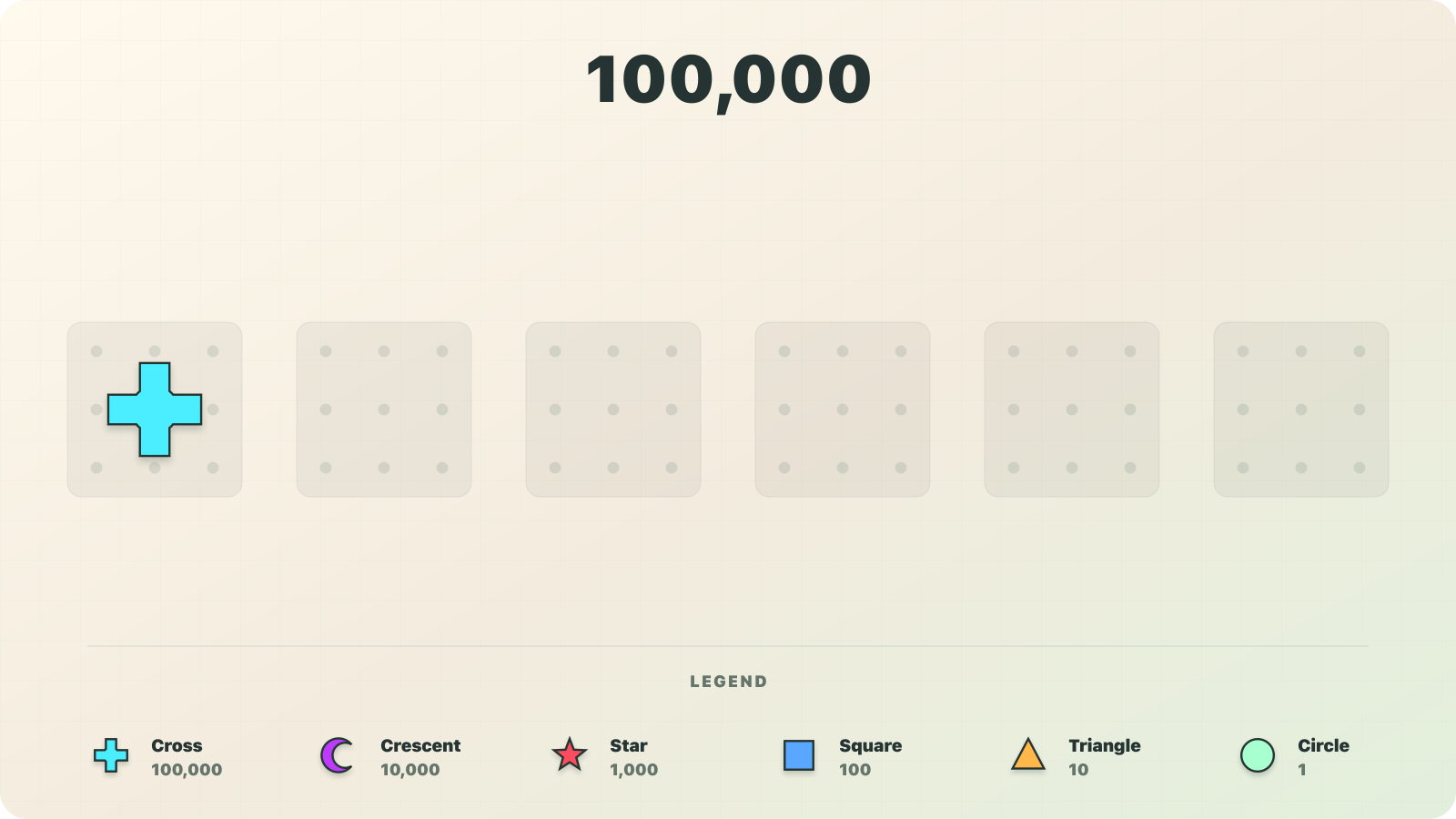
One hundred thousand is the smallest six-digit whole number and is represented by one cross-shaped fixed-value symbol.
These PNG and SVG visualization files are dedicated under CC0 1.0 Universal. You may use them for any purpose without asking permission or giving credit. They are ready for classroom lessons, worksheets, presentations, and home math practice. Read the scope and exclusions.
Read the visual
Fixed-value symbol model for 100,000
one unit in the hundred-thousands place
One cross-shaped fixed-value symbol worth 100,000 represents the entire number; every lower decimal place contains zero units.
This additive decimal model decomposes the number into repeated fixed-value symbols. Each symbol keeps its value wherever it appears, and repetitions add, so the complete pattern composes 100,000.
- one unit in the hundred-thousands place
- 100,000
Number profile
Facts about 100,000
- Standard form
- 100,000
- Number name (word form)
- one hundred thousand
- Expanded form
- 100,000
- Classification
- Even and composite
- Prime factorization
- 25 × 55
- Positive divisors (36)
- 1, 2, 4, 5, 8, 10, 16, 20, 25, 32, 40, 50, 80, 100, 125, 160, 200, 250, 400, 500, 625, 800, 1,000, 1,250, 2,000, 2,500, 3,125, 4,000, 5,000, 6,250, 10,000, 12,500, 20,000, 25,000, 50,000, 100,000
- Digits
- 6
- Digit sum
- 1
- Digital root
- 1
- Fixed-value symbols
- 1
Created and reviewed by Entropycal Studio LLC · Reviewed · How this page was created and checked
Why it stands out
Patterns inside 100,000
One hundred thousand introduces Numerosidad’s highest fixed-value symbol and marks the exact transition from five-digit to six-digit numbers.
It begins the six-digit range
Adding 1 to 99,999 produces 100,000, the first whole number whose decimal notation uses six digits.
Its prime factorization is 2⁵ × 5⁵
The exponents produce (5 + 1)(5 + 1) = 36 positive divisors.
One symbol worth 100,000 regroups ten symbols worth 10,000
A single hundred-thousand has the same value as ten ten-thousands, one hundred thousands, or one hundred thousand ones.