
Choose your path
Visual number resources for every learner
One shared set of free tools, with clear starting points for teachers, parents and families, and students.
Choose the path that fits what you need today. Every path uses the same Number Atlas, reviewed number pages, browser Challenge, and free Numerosidad game, so there is no separate account, curriculum, or duplicate website to navigate.
One visual language
The same number can support different goals
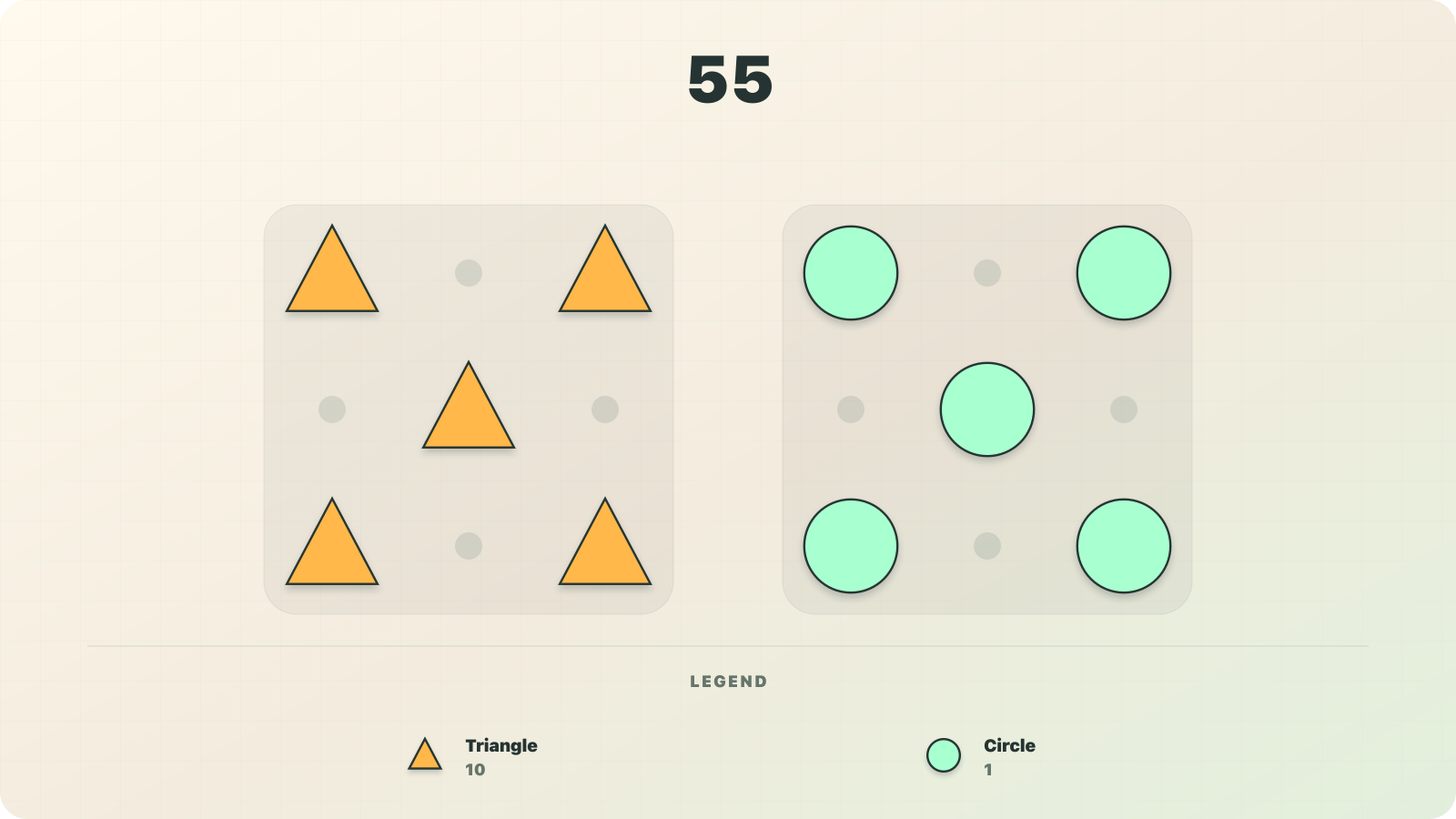
A teacher can place this image in a lesson, a family can discuss how 55 is composed, and a student can use the same visual rule in the Number Challenge.
Explore the number 55For teachers
Plan a number-composition lesson or discussion
Use the Atlas to connect standard form, number names, expanded form, and fixed-value symbols. Generate an additive symbol model for the exact whole number your class is discussing, from 1 through 999,999.
- Compare ordinary positional digits with an additive fixed-value symbol system.
- Read, write, compose, and decompose multi-digit whole numbers.
- Compare Lineup, Shuffle, Scatter, Mix-Up, and Chaos visual representations.
- Download PNG or SVG images for lessons, worksheets, and presentations.
For parents and families
Make number composition visible at home
Start with a birthday, house number, score, or another whole number your family recognizes. Use the legend to name each symbol’s fixed value, add the repeated symbols, and compare the result with the written number.
- Choose: enter a familiar number in the Atlas.
- Talk: ask what each digit is worth and how the number can be expanded.
- Play: try a browser Challenge together or open the free game.
For students
Explore, practice, and play
Choose how you want to begin. You can look closely at one number, practice reading fixed-value symbol patterns in your browser, or play the complete arcade game.
The rule stays consistent: each symbol has a fixed value, repetitions add, and moving a symbol does not change what it is worth.