
Practice together
Number composition help for families
Turn one familiar whole number into five or ten minutes of useful home math practice.
Parents and caregivers do not need a lesson plan or special materials. Choose a number, compare its positional digits with Numerosidad’s fixed-value symbols, read it aloud, and ask how both representations compose the same amount. Stop while the conversation still feels manageable and return another day.
Start small
A five-minute home math routine
- 01Choose
Use an age, score, page number, date, or another whole number that already has meaning.
- 02Notice
Ask which symbols repeat, what fixed value each carries, and whether standard notation contains a zero.
- 03Read
Say the number aloud from its greatest occupied place to the ones.
- 04Build
Write the number in standard form and expanded form.
- 05Explain
Ask how the fixed-value symbols add to the same amount as the written number.
From hundreds to hundred-thousands
Make reading large numbers less crowded
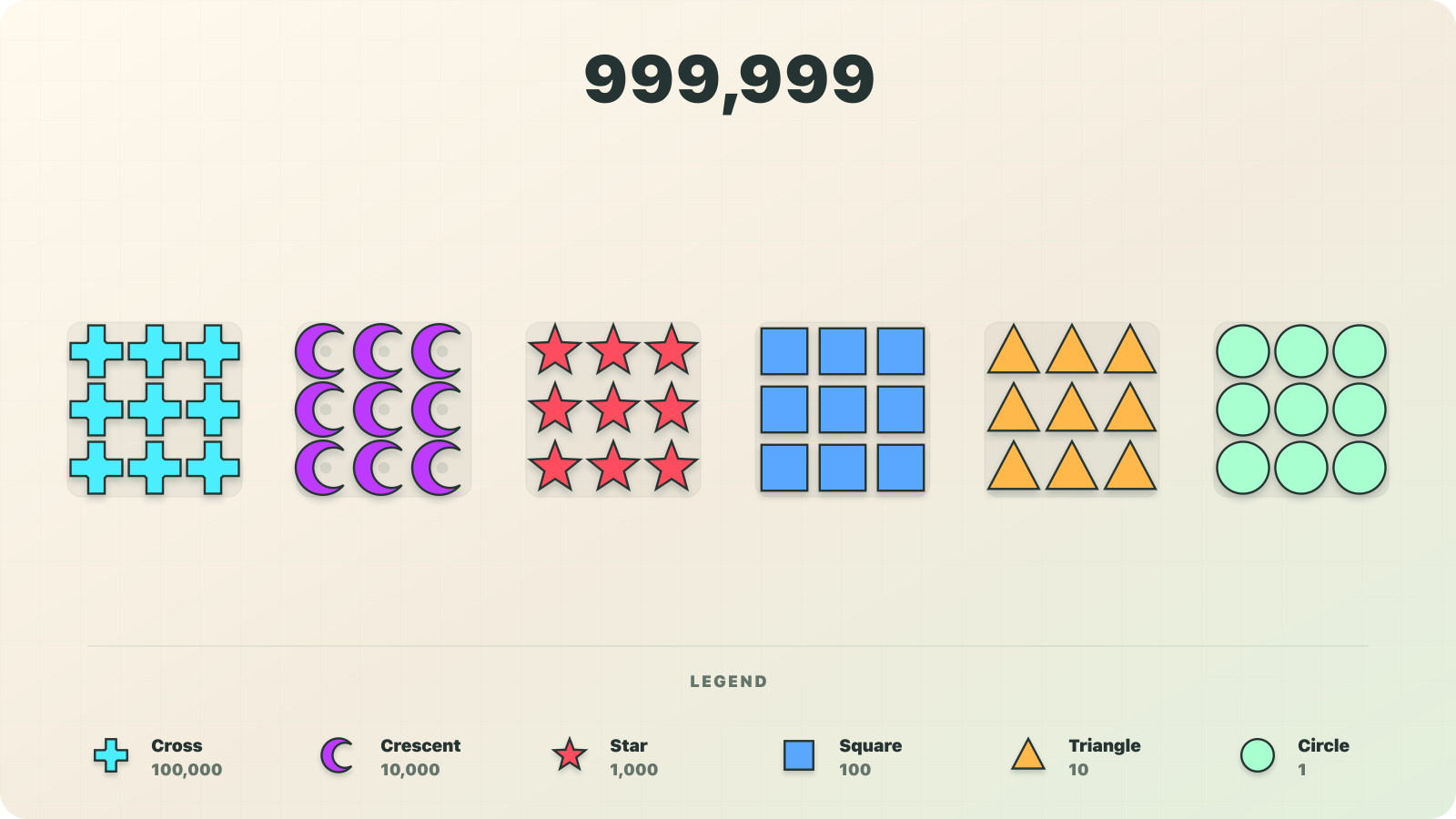
Read by place
999,999
Begin with the hundred-thousands. Name one place at a time, then connect the complete number to its written form: nine hundred ninety-nine thousand, nine hundred ninety-nine.
Explore 999,999 step by stepStart at the greatest place
Find the leftmost occupied place before reading the number. That gives the child a clear starting point.
Pause at thousands
Read the thousands group, say thousand, then read the final hundreds, tens, and ones.
Keep zero visible
An empty place still matters in the written number. Compare 1,204 with 1,024 and ask what each zero is holding.
Think beyond the answer
Three kinds of number sense practice
Compare
Which number is greater?
Compare 50,670 and 50,607. Find the greatest place where the digits differ and explain why that place decides.
Change
What if one place changes?
Start with 144. Add one ten, remove one hundred, or add one unit. Predict the new number before rebuilding it.
Represent
Can you show it two ways?
Connect the visual model to standard form, number words, or expanded form. Ask what stays equal across every representation.
When something is confusing
Simple number-reading help for caregivers
A digit is named without its value
Ask: “Does this 5 mean 5, 50, 500, or another amount?” Point to the place before asking for the full number.
A zero disappears while reading
Write every place in order. Name the empty place and explain that zero keeps the other digits in their correct positions.
Every symbol is counted as one
Use the legend first. Count each symbol, multiply by its fixed value, and then add the contributions. Moving a symbol does not change what it is worth.
A large number feels overwhelming
Cover the lower places and begin with the greatest place. Reveal one place at a time, or switch to a smaller number and return later.