
Numerosidad Number Atlas
The number 8, visualized
Eight is simultaneously a perfect cube, a Fibonacci number, and a power of two, making it an unusually rich one-digit value.
These PNG and SVG visualization files are dedicated under CC0 1.0 Universal. You may use them for any purpose without asking permission or giving credit. They are ready for classroom lessons, worksheets, presentations, and home math practice. Read the scope and exclusions.
Read the visual
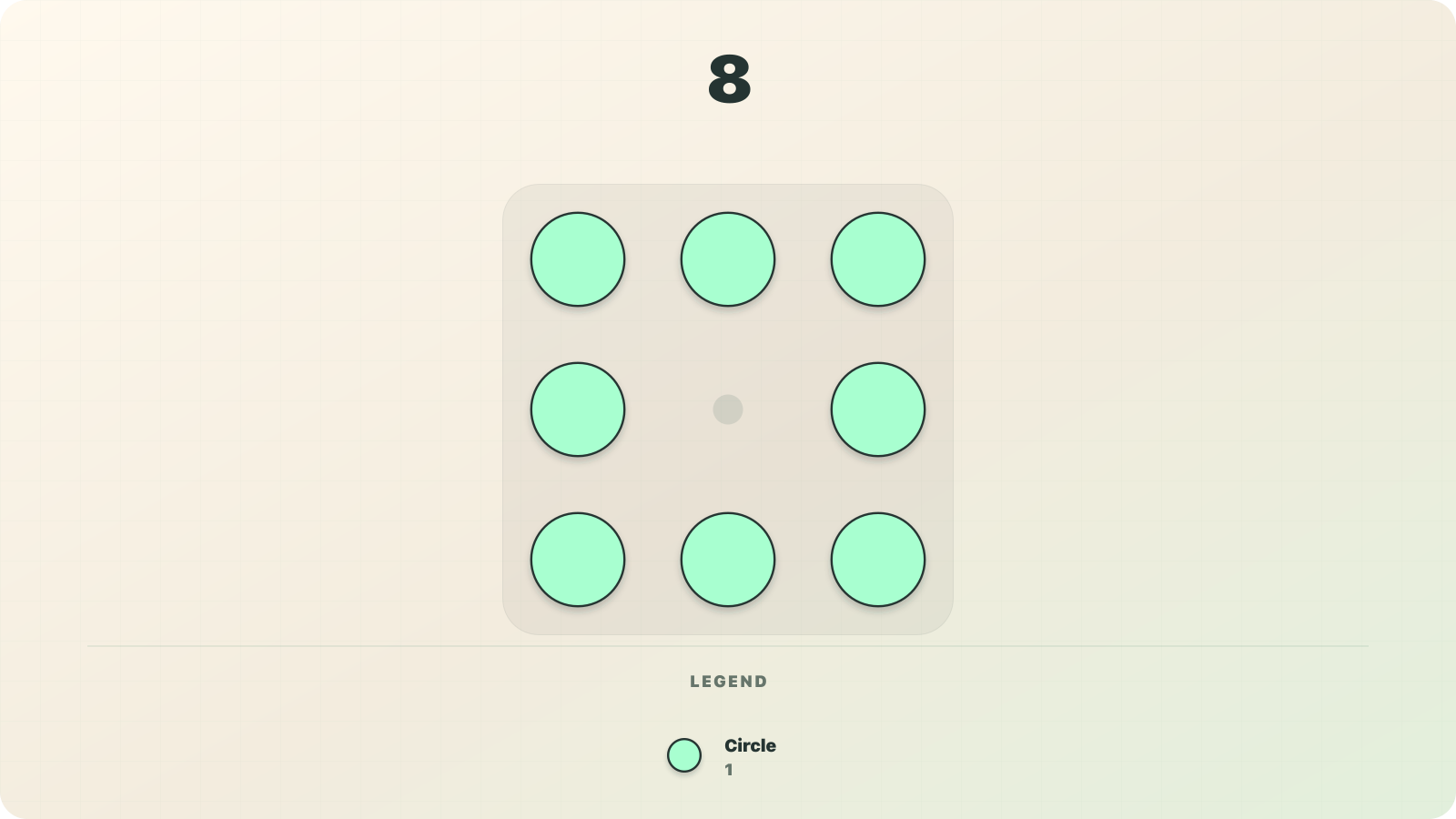
Fixed-value symbol model for 8
eight ones
Eight circle-shaped fixed-value symbols worth 1 each supply the ones digit and combine to make 8.
This additive decimal model decomposes the number into repeated fixed-value symbols. Each symbol keeps its value wherever it appears, and repetitions add, so the complete pattern composes 8.
- eight ones
- 8
Number profile
Facts about 8
- Standard form
- 8
- Number name (word form)
- eight
- Expanded form
- 8
- Classification
- Even and composite
- Prime factorization
- 23
- Positive divisors (4)
- 1, 2, 4, 8
- Digits
- 1
- Digit sum
- 8
- Digital root
- 8
- Fixed-value symbols
- 8
Created and reviewed by Entropycal Studio LLC · Reviewed · How this page was created and checked
Why it stands out
Patterns inside 8
The number 8 shows how repeated multiplication, repeated doubling, and Fibonacci addition can arrive at the same value.
Three factors of 2 build a cube
The equation 8 = 2 × 2 × 2 = 2³ makes 8 both the cube of 2 and a power of two.
It also arrives by Fibonacci addition
The preceding Fibonacci numbers 3 and 5 add to 8, and 5 + 8 produces the next value, 13.
Its prime factorization uses only 2
Because 8 = 2³, every nontrivial positive divisor of 8 is itself a power of two.