
Equal factors
Perfect squares connect a number to itself
Compare products of the form n × n from one unit through 10,000.
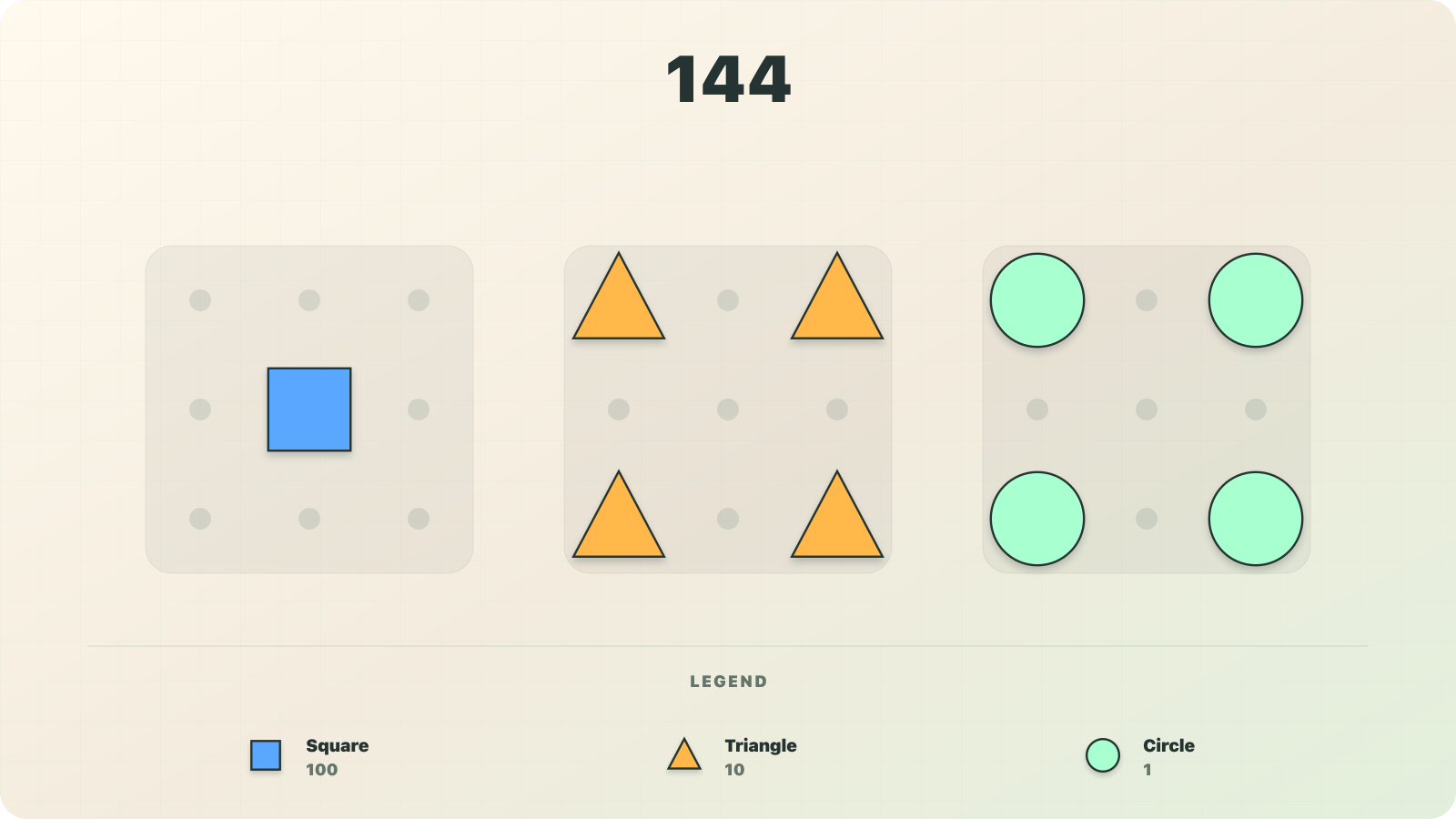
A perfect square is an integer that can be written as n multiplied by itself. A geometric square uses n rows and n columns, while the Number Atlas image shows the same total with additive fixed-value symbols. Using both representations separates multiplicative structure from symbol-based composition.
The rule
Use two equal factors
Curated collection
144
A whole number equals n multiplied by itself. 7 reviewed square values.
Explore the reviewed page for 144The equation n × n = n² defines a perfect square. For example, 5 × 5 = 25, 10 × 10 = 100, and 12 × 12 = 144.
The square root identifies the repeated factor. The square root of 144 is 12 because 12 × 12 equals 144.
The reviewed examples are not every square within the Atlas range. They are selected pages that also support standard-notation boundaries, powers of ten, and sequence intersections.
Reviewed products
Perfect squares already in the permanent collection
The note under each link names its whole-number square root and multiplication form.
Reviewed perfect-square pages
Each note gives the repeated factor.
Look closely
Patterns worth comparing
Last-digit possibilities
In base ten, a perfect square can end in 0, 1, 4, 5, 6, or 9, but never in 2, 3, 7, or 8.
Squares can cross topics
1 is triangular and Fibonacci, 144 is Fibonacci, and 100 plus 10,000 are powers of ten as well as squares.
Zeroes grow in pairs
Squaring 10 gives 100 and squaring 100 gives 10,000. Each factor contributes its zeroes to the product.
Use the collection
Connect factors, roots, and visuals
- 01Name the root
Before opening a page, identify the whole number that multiplies by itself to produce the square.
- 02Compare two representations
Sketch an n-by-n array, then explain how the Atlas image reorganizes the same total by decimal place.
- 03Find a missing square
Visualize a square such as 16 or 36 in the Atlas and compare it with the reviewed pages without treating it as a new indexed page.
Keep exploring