
Additive sequence
Fibonacci numbers, connected visually
Follow repeated addition from small one-digit values into three-digit decimal structure.
In the Fibonacci sequence, each term after the opening values equals the sum of the two terms before it. The full sequence is commonly written 0, 1, 1, 2, 3, 5, 8, and onward. Because the Number Atlas begins at 1 and this collection links distinct reviewed pages, the page for 1 appears once even though the sequence contains two consecutive 1s.
The rule
Add the previous two terms
Curated collection
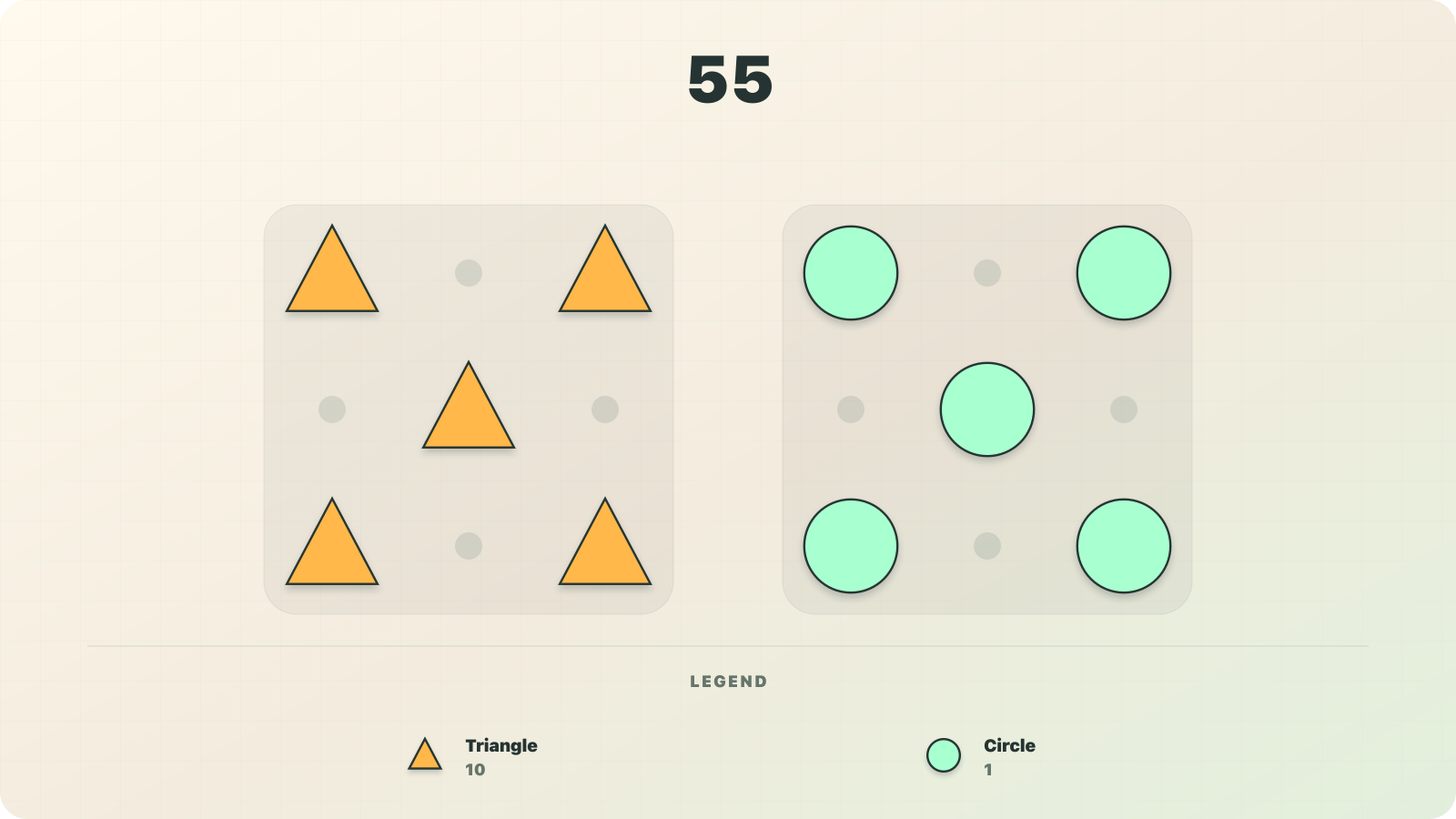
55
Each new term is the sum of the previous two terms. 11 reviewed values from 1 through 144.
Explore the reviewed page for 55The recurrence is simple: after the opening pair, combine the two preceding values to obtain the next one. For example, 8 + 13 = 21, 13 + 21 = 34, and 34 + 55 = 89.
A number-symbol visualization does not draw a spiral or a geometric Fibonacci diagram. It shows the decimal composition of each term, making it possible to compare how the sequence grows across ones, tens, and hundreds.
The reviewed collection ends at 144 for now. Larger Fibonacci values can still be visualized in the interactive Atlas when they fall within the supported range, but they are not presented here as permanent reviewed pages.
Reviewed sequence
Distinct positive Fibonacci pages in the collection
Read the links in sequence order. The note under each number identifies the addition that produces it from the preceding terms.
Sequence order
Each linked page is already part of the reviewed permanent collection.
Look closely
Patterns worth comparing
Digit-length boundaries
The sequence moves from one digit to two digits at 13 and from two digits to three digits at 144. Compare what changes in the visual model at each boundary.
Odd and even do not alternate
The parity pattern repeats odd, odd, even. In the reviewed values, 2, 8, and 34 are even while their neighboring Fibonacci values are odd.
Families can overlap
1 is square and triangular, 3 and 21 are triangular, 55 is triangular and palindromic, and 144 is a perfect square.
Use the collection
Use the reviewed pages as a sequence
- 01Predict
Open two consecutive values, add them, and predict the next Fibonacci number before following its link.
- 02Compare
At 13, 21, 34, 55, and 89, compare the tens and ones contributions rather than looking only at the complete numeral.
- 03Cross over
Open 21, 55, or 144 and identify the second mathematical topic that the number belongs to.
Keep exploring