
Digit symmetry
Palindrome numbers read both ways
Compare numbers whose digit order remains unchanged from left to right and right to left.
A number palindrome has the same sequence of digits when read forward or backward. Every one-digit number is therefore a palindrome. Larger palindromes make the symmetry easier to see because matching digits occupy mirrored places, such as the tens and ones in 55 or all six places in 999,999.
The rule
Reverse the digits, not the value of each place
Curated collection
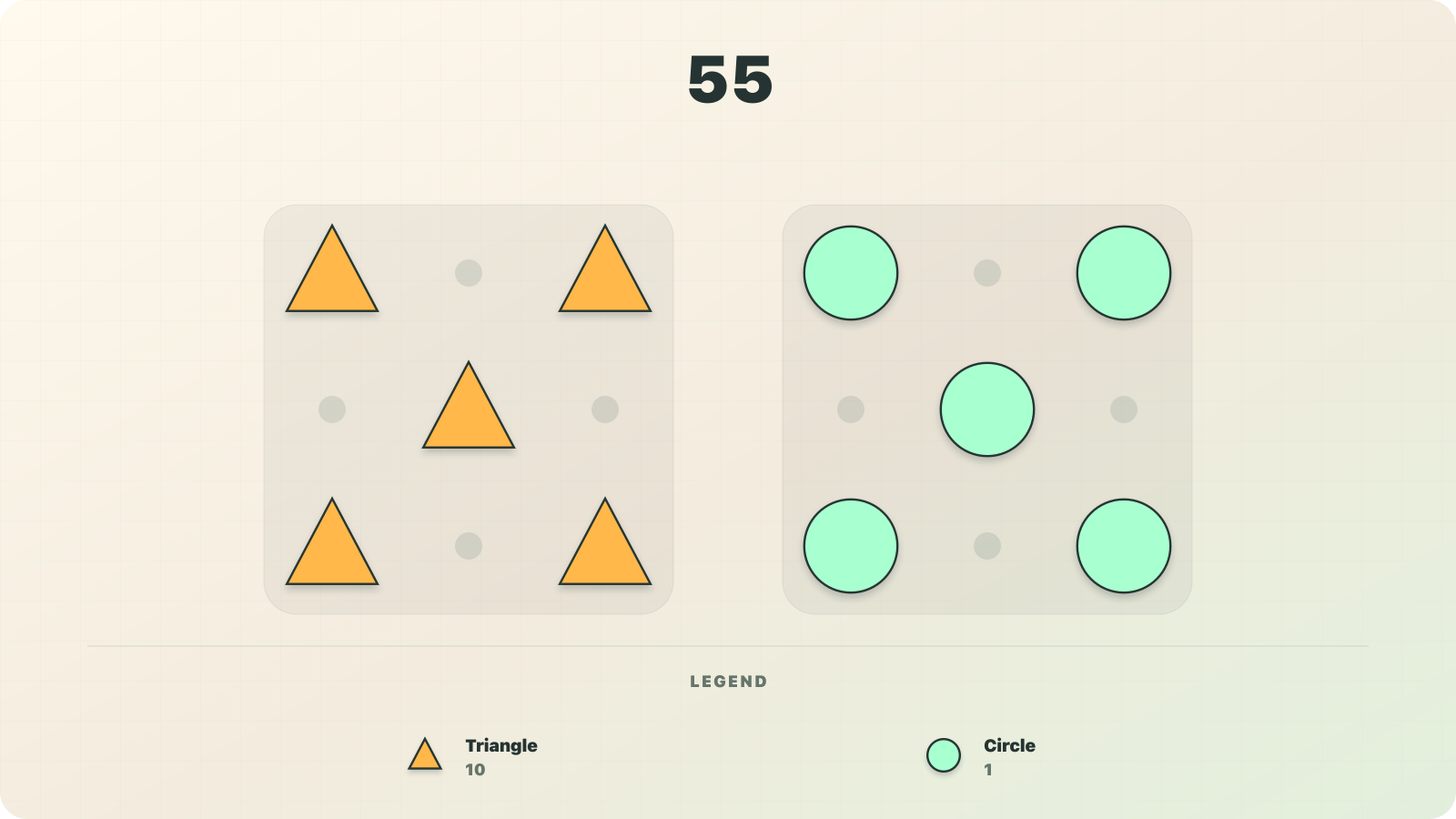
55
Its digit sequence is unchanged when reversed. 12 reviewed palindromes.
Explore the reviewed page for 55In 55, the tens digit and ones digit match. In 999,999, the hundred-thousands digit matches the ones digit, the ten-thousands digit matches the tens digit, and the thousands digit matches the hundreds digit.
Palindrome describes written digit order in a chosen base. It does not mean that mirrored places have equal value: the left 5 in 55 contributes 50, while the right 5 contributes 5.
This page groups only palindromes already included in the reviewed collection. It does not generate a permanent page for every palindrome within the Atlas range.
Reviewed symmetry
Palindrome pages in the permanent collection
Start with the one-digit cases, then compare repeated two-digit and six-digit examples where mirrored digits contribute different values in positional notation.
One-digit palindromes
Reversing one digit cannot change its order.
Larger reviewed palindromes
Repeated digits make the mirrored positions explicit.
Look closely
Patterns worth comparing
Same digit, different positional contribution
In standard notation, one 5 in 55 contributes 50 and the other contributes 5 because their positions differ.
Repdigits are palindromes
11, 55, and 999,999 repeat one digit, so reversing their order cannot change the numeral.
Not every palindrome repeats one digit
A numeral such as 121 is palindromic without being a repdigit. It can be visualized in the Atlas even though it is not a reviewed permanent page.
Use the collection
Read symmetry in positional notation
- 01Reverse
Write a reviewed numeral backward and confirm that the digit sequence remains the same.
- 02Value each digit
For 55 or 999,999, name the contribution of each repeated digit from greatest place to ones.
- 03Test a new example
Enter a non-reviewed palindrome such as 121 in the Atlas, then explain why it belongs to the family without creating a new permanent page.
Keep exploring