
Decimal composition
From multi-digit place value to fixed-value symbols
Read, compose, decompose, and compare reviewed whole numbers across every supported digit length.
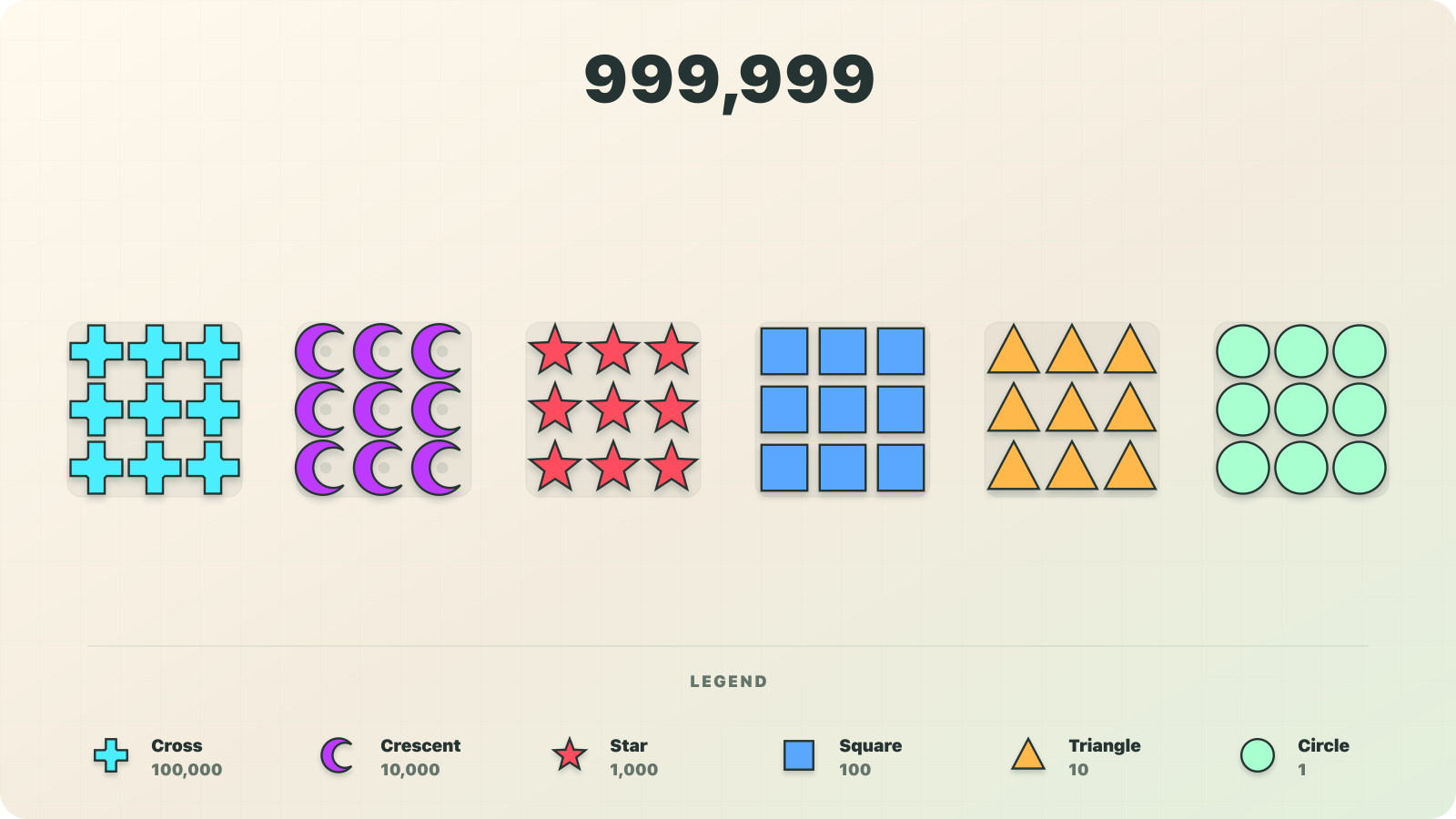
In ordinary positional notation, a digit's contribution depends on its position: moving one place left multiplies that contribution by 10. Numerosidad works differently. Each symbol has a fixed value, repetitions add, and moving a symbol does not change what it is worth. The reviewed pages connect those two representations.
The rule
A digit and its place determine its value
Curated collection
999,999
Each position is worth ten times the position to its right. 17 reviewed multi-digit pages.
Explore the reviewed page for 999,999In 55, the first 5 is worth 50 and the second is worth 5. The digit is the same, but its position changes its contribution.
Zero holds an empty position in standard notation. In 100, the two zeroes preserve the 1 in the hundreds position even though no fixed-value symbols worth 10 or 1 are present.
The Atlas supports six places: ones, tens, hundreds, thousands, ten-thousands, and hundred-thousands. The curated groups below include existing reviewed examples at every digit length from two through six.
Reviewed by digit length
Multi-digit pages across all supported places
Move from two digits to six. Within each group, compare repeated digits, zero placeholders, and changes in the greatest occupied place.
Two-digit reviewed pages
Compare tens and ones across varied digit patterns.
Three-digit reviewed pages
Hundreds join tens and ones.
Four- and five-digit boundaries
Each power of ten introduces a new greatest place.
Six-digit reviewed pages
The collection includes the lower boundary and Atlas maximum.
Look closely
Patterns worth comparing
Repeated digits can have different values
In 11, 55, and 999,999, matching digits contribute different amounts because each occupies a different decimal place.
Zero preserves position
The powers-of-ten pages show one occupied place and several empty places. Standard notation still records those empty places with zeroes.
Digit count locates magnitude
A two-digit number is at least 10, while a six-digit number is at least 100,000. The leftmost occupied place establishes the range.
Use the collection
Read and compare by place
- 01Name contributions
Choose a page and state what each nonzero digit contributes before combining the parts.
- 02Compare from the left
For two numbers with the same digit count, find the greatest place where their digits differ. That place determines which number is larger.
- 03Change one magnitude
Add or remove one fixed-value symbol of a chosen magnitude and predict how the standard and expanded forms change.
Keep exploring